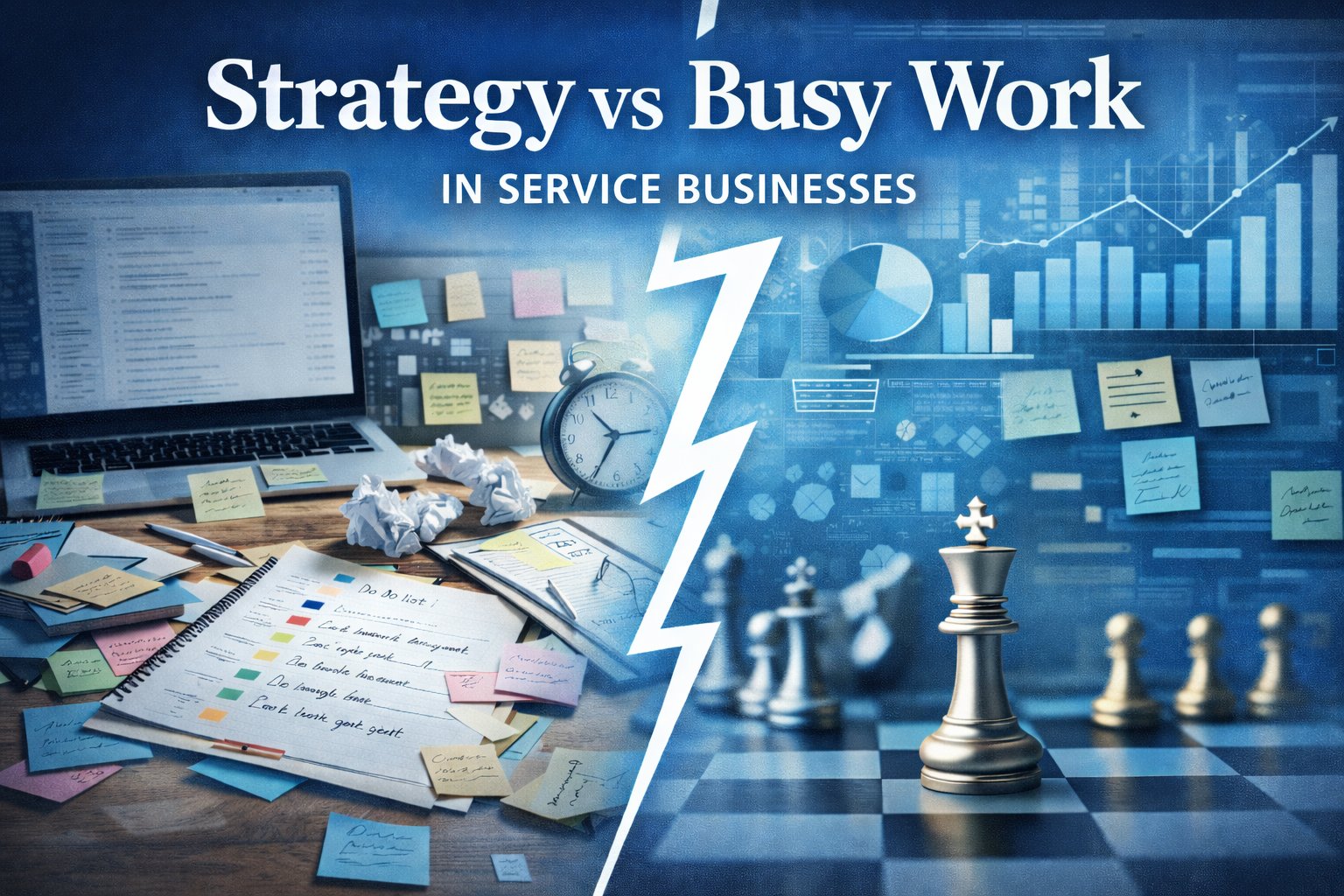
In service businesses, activity often gets mistaken for progress. Emails are answered, tickets are closed, meetings fill the calendar, and reports are generated. At the end of the week, everyone feels exhausted, yet very little has fundamentally improved. Being busy creates the illusion of momentum, but motion is not the same as direction.
Why Busy Work Feels Productive
Busy work delivers immediate feedback. You clear an inbox and feel accomplished. You solve small problems and see instant results. Strategy, however, is slower and less visible. It requires thinking, making deliberate choices, and sometimes accepting short-term discomfort for long-term gain. Because busy work produces quick wins, it becomes addictive. Teams default to reacting instead of intentionally shaping the future.
The Cost of Constant Reaction
When a business operates in reaction mode, priorities are set by whoever shouts the loudest. Clients dictate urgency, internal issues interrupt focus, and competitors influence decisions. Over time, leadership becomes operational rather than strategic. The organisation may survive, but it rarely scales intentionally. Without strategy, effort compounds very little. The business stays active, but growth plateaus.
What Strategy Actually Looks Like
Strategy is not a slogan or a once-a-year planning session. It is a clear set of choices about where to compete, how to win, and what to deliberately ignore. It defines your ideal client, your pricing position, your service boundaries, and your resource allocation. Most importantly, strategy requires trade-offs. If everything is important, nothing is strategic.
Protecting Strategic Time
In service businesses, strategic thinking must be scheduled and protected. It does not happen in the gaps between support calls. Leadership time should include structured review of client profitability, service positioning, team capability, and competitive threats. When leaders remain buried in operations, the business becomes dependent on their presence rather than guided by their direction.
The Bottom Line
Strategy vs busy work is not about effort. It is about intention. Busy work keeps the lights on, but strategy determines where the business is heading. Service businesses that scale sustainably are not the busiest. They are the most deliberate. They choose where to focus, where to say no, and how to align effort with long-term positioning.




Recent Comments